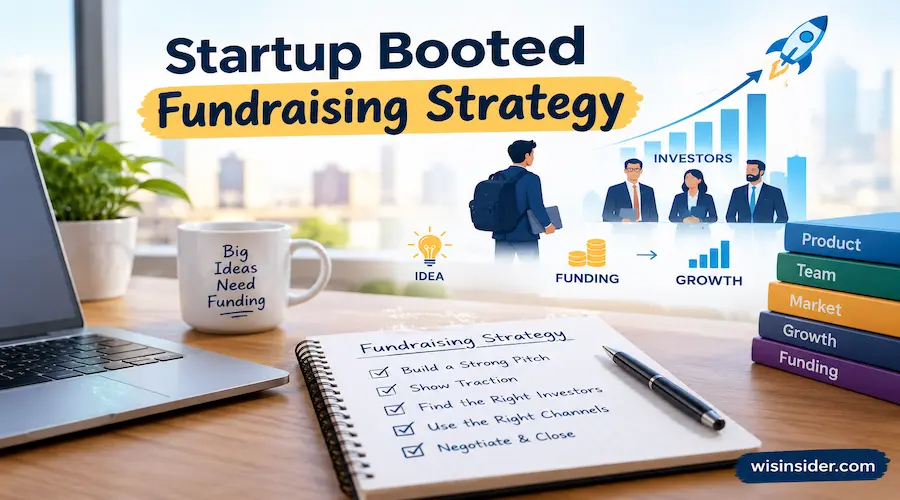
Startup Booted Fundraising Strategy: Raise Money and Keep Your Company

Quick answer: A startup booted fundraising strategy means you earn your first dollars from customers. You raise outside money later, and only when it speeds up something that already works. You keep more of your company, and you set the terms.
Most founders ask, “How do I raise money?” That is the wrong first question. A better one is, “What will this money buy that my own cash cannot?”
This guide answers that question with 2026 data from Carta, SaaS Capital, and Y Combinator. It shows the cap table math that most guides skip. It also tells you when bootstrapping is the wrong move, because sometimes it is.
What Does “Startup Booted” Actually Mean?
“Startup booted” is how many people type “bootstrapped startup.” The word “booted” has no formal meaning in finance. Investors, lenders, and founders all say “bootstrapped.” This article uses your search phrase once and then sticks to the standard term.
A bootstrapped startup grows on founder savings and customer revenue. It does not depend on outside equity. Y Combinator frames the big choice as bootstrapping or raising from venture capital firms.
A startup booted fundraising strategy is not a vow to avoid investors. It is a plan for when, why, and how you take outside money. You build first. Then you raise on purpose.
Plain words box
- Bootstrapping: building with your own money and customer revenue.
- Dilution: your share of the company shrinks when you sell shares.
- Non-dilutive funding: money that does not cost you equity, such as grants.
- Cap table: a list that shows who owns what.
- Runway: the months of cash you have left.
- Pre-seed and seed: the first two small rounds of outside money.
Why Does This Strategy Work Better in 2026?
Growth has cooled across software. SaaS Capital surveyed more than 1,000 private B2B software companies in 2025. Median growth for 2024 came in at 25%, down from 30% in 2023. Slower markets reward businesses that make money.
Bootstrapped companies already live by that rule. SaaS Capital’s 2026 benchmarks show bootstrapped firms with $3 million to $20 million in annual recurring revenue growth at a median of 15%. Their net revenue retention sits near 103%. The top tenth grow at 42.3% or more. One analyst summary of the same survey reports that 83% of bootstrapped firms were profitable or near breakeven. Only 52% of equity-backed firms were.
Now look at the venture side. Carta reports that the median seed round in the six months to July 2026 raised $4.1 million at a $24.3 million valuation. Median dilution was 18%. Those numbers look friendly. Yet a seed market brief built on Carta data says more than 60% of Q1 2026 dollars went to AI companies. If you do not build AI, expect a harder room.
Here is the honest counterpoint. Investor Tomasz Tunguz built a simple model in 2017. One team spends $150,000 of its own money. Another sells 25% of its company for $1.5 million. Both execute perfectly. The funded team grows faster because it buys customers sooner.
His conclusion is plain. Raise when you can turn the money into faster growth, and when that speed is worth the dilution.
So the 2026 case is not “never raise.” It is “raise with leverage.”
Should You Raise Money at All? Six Honest Tests
Raise only if outside money buys something your own cash flow cannot. Run these six tests first. If you fail two or more, wait.
- The speed test. Does a faster pace win you the market? Winner-take-all markets and network effects reward speed. A niche business tool usually does not.
- The channel test. Can you turn a dollar into customers on repeat? If you have one channel that works, money is fuel. If not, money only delays the bad news.
- The runway test. Can you reach breakeven in 12 to 18 months without help? If yes, you may never need to raise.
- The plan test. Can you say what you will do with the money in one sentence? “Hire two sellers to open a second channel” passes. “Grow the team” fails.
- The risk test. Can you survive a failed raise? Check your personal savings and your full time income. Quitting a job to bootstrap is a real financial risk.
- The control test. Are you ready for board seats, reports, and an exit plan? Investors expect a large outcome. That changes how you run the company.
When bootstrapping is the wrong move
Y Combinator’s fundraising guidance notes that some companies need capital to reach their first fundable milestone. Hardware and deep tech are common examples. Chips, devices, and lab work cost money before the first sale. Grants help, but they rarely cover the whole gap.
Be careful with advice that says every founder should bootstrap. A slower company in a fast market can lose, even with perfect books.
How Do You Fund the Company Before You Raise?
Customers should be your first investors. A paying customer gives you cash and proof in one move. Here are five ways to get both.
- Sell before you build. Offer pre-sales or pre orders. A buyer who pays up front tells you the idea has value. Refund anyone you cannot serve.
- Charge for pilots. A free trial teaches you little. A paid pilot teaches you who has a budget.
- Ask for annual prepayment. Offer a small discount for a full year up front. You get cash today and lower churn.
- Sell the service first. Solve the problem by hand for a few clients. Their fees pay the bills. The repeat work shows you what to automate.
- Use your own savings with a hard cap. Pick a number you can lose. Write it down. Stop when you reach it.
Keep costs low without hurting the product
Lean operations mean spending only on what moves revenue. Use contractors before employees. Pick two tools, not ten. Our guide to growth navigate startup tools shows how to build a small stack.
Consider a fractional CTO if you lack a technical partner. This is a senior engineer who guides your build part time for a monthly fee. It costs less than a full time hire. It also keeps your equity intact.
Build financial discipline early
Cash flow management decides who survives. Update a simple weekly forecast. List the cash coming in, the cash going out, and the date you run dry. Review it every Monday. Investors trust founders who know that date without checking.
Which Non Dilutive Funding Can You Use?
Non-dilutive funding is money that does not cost you shares. It still has a price. You pay with cash flow, rules, or time. The table shows the main options.
| Option | What you give up | Fits best | Watch out for |
| Revenue-based financing | A fixed share of monthly revenue until you repay | Software firms with steady recurring revenue | Payments rise as sales rise |
| Term loans and credit lines | Interest and, at times, personal guarantees | Companies with predictable cash flow | Payments are due even in slow months |
| Venture debt | Interest, rules, and sometimes warrants | Startups that already raised equity | Warrants can make it dilutive |
| Grants such as SBIR, NSF, Horizon Europe | Time spent on applications and reports | Research, deep tech, and public interest work | Slow decisions and strict spending rules |
| Inventory and purchase order financing | A fee on each financed order | Product brands with stock to buy | Fees add up on thin margins |
| Rewards crowdfunding | Delivery duty to every backer | Consumer products with an audience | A failed campaign is public |
What the numbers look like
Lighter Capital described revenue-based financing in 2019 as a revenue share of roughly 2% to 8%. It targeted startups with at least $15,000 in monthly recurring revenue. Founderpath publishes different terms today. Its revenue financing starts at a 7% discount rate. Its term loans start at 15% interest. It says offers depend on underwriting.
Treat all of these as starting points. Pricing changes by lender, country, and your numbers. Read the contract and ask what happens if sales drop.
Caution about grants
Grants are the cheapest money, but the application costs real hours. Treat them as a bonus unless your work fits a program well. Check each program’s rules and dates before you plan around it.
What Does a Raise Really Cost You? The Cap Table Math
The headline number hides the real cost. A “20% round” rarely takes only 20%. Here is the math in three short steps.
Step 1: How a SAFE works
A SAFE is a Simple Agreement for Future Equity. Y Combinator created it in 2013 and moved to a post-money version in 2018. The investor’s share equals the amount invested divided by the post-money valuation cap. Put $500,000 into a SAFE with a $10 million cap, and the investor gets 5%. The Y Combinator SAFE page offers a free calculator and templates.
Each new SAFE takes its share from the founders and earlier shareholders. Three SAFEs of 5% each cost you about 15% before any priced round.
Step 2: The option pool shuffle
Investors usually want a pool of shares set aside for future hires. They often ask you to create it before their money goes in. That puts the whole cost on you.
Say you own 100% and raise $2 million at an $8 million pre-money valuation. The investor owns 20% after the round. Now add a 10% pool, placed in the pre-money. The investor still owns 20%. The pool holds 10%. You hold 70%. Your real pre-money value fell from $8 million to $7 million.
You can negotiate. Ask for a smaller pool backed by a hiring plan. Or ask for a higher valuation to offset it.
Step 3: Compare with the medians
| Measure | Median | Source |
| Dilution in a seed round | 18% | Carta, six months to July 2026 |
| Option pool at seed | 11.8% | Carta, as reported by Waveup |
| Founder ownership after seed | About 56% | Carta, as reported by Waveup |
| Founder ownership after Series A | About 36% | Carta, as reported by Waveup |
These medians include AI companies, which raise at higher prices. Your numbers may differ. Use a cap table tool before you sign anything, and ask a startup lawyer to check the terms.
What Do Investors Check Before They Say Yes?
Investors want proof that money turns into growth. Your best card is that you already did it with little. Bring these numbers.
| Metric | What it shows | Reference point |
| Revenue growth | Is demand compounding? | 15% median and 42.3% for the top tenth, bootstrapped SaaS at $3M to $20M ARR (SaaS Capital, 2026) |
| Net revenue retention | Do customers stay and spend more? | About 103% median, same group (SaaS Capital, 2026) |
| CAC payback | How fast a customer repays what you spent to win them | Under 6 months for B2B SaaS, per one 2026 guide |
| LTV to CAC | Does each customer earn more than they cost? | 3 to 1 or better, per the same guide |
| Gross margin | Can the business scale with profit? | Above 60%, per the same guide |
| Burn multiple | Cash burned for each new dollar of revenue | Lower is better |
| Runway | Months until the cash ends | Know it to the week |
The last three reference points come from one guide and are rules of thumb, not laws. Hardware, marketplaces, and services are judged differently. Ask investors in your sector what they expect.
Show your work before you ask
Start the relationship early. A Northwestern Medill report quotes advice to meet investors before you need money, so they can track your progress. Send a short monthly update to five or ten investors who fit your stage. Share revenue, one win, one problem, and one ask. After six months, you are no longer a stranger.
Tell the weak parts first
Say your weakest number out loud. “Churn is higher than I want, and here is the fix I am testing” builds trust. Investors find weak spots in due diligence anyway.
How Do You Keep Control? Board Seats and Terms
Control often matters more than a few points of equity. Losing control means you can lose your own company’s direction. Watch these terms.
- Instrument. A SAFE delays the price talk. A priced round sets the valuation today and adds more legal terms. A SAFE gives no shares until it converts, so it brings no vote by itself.
- Board seats. Investors who lead a priced round often ask for one. Tomasz Tunguz says you will likely grant a board seat to an investor. At seed, try to keep a board that founders control.
- Option pool. Treat pool size and placement as a price term, as the math above shows.
- Pro rata rights. This is the right to buy shares in later rounds. Y Combinator offers it as a separate side letter. Agree to it only for investors who add real value.
- Liquidation preference. This decides who gets paid first in a sale. A simple 1x version is common. Ask your lawyer to flag anything heavier.
- Vesting. Investors often expect founder shares to vest over time. Know your schedule before they ask.
One rule for every term sheet
Compare offers on control and cost, not only on valuation. A lower price with clean terms can beat a high price with strings.
Hire a startup lawyer before you sign. A few hours of advice costs far less than a clause that bites in year four. This article is general information, not legal or financial advice.
What Can Public Cases Teach You?
These are public stories, not mine. They show different routes to the same idea. Each one kept leverage until it chose its terms.
- Mailchimp. It grew without venture funding and sold to Intuit for about $12 billion, as widely reported. Lesson: a customer-funded company can reach a huge outcome while founders stay in control.
- Basecamp. It stayed independent and profitable, and its founders wrote openly about wanting a calm company. Lesson: you can define success on your own terms.
- Calendly. One venture analysis lists it among bootstrapped or mostly bootstrapped companies. Lesson: “mostly” is a real option. Many founders raise a small amount late.
- Atlassian. Tunguz called it the best known bootstrapped software company in his 2017 post. Lesson: bootstrapping and big ambition can coexist.
The failure side
Stories of founders who waited too long rarely get written. They matter too. The same VC analysis warns that a bootstrapped company usually grows slower than a funded rival. In winner-take-all markets, that gap can be fatal. Run the six tests above before you copy any success story.
Add your own story here
Readers trust firsthand results. If you have raised money, skipped a raise, or watched one fail, add a short account with real numbers. Place it just before the mistakes section.
Which Tools and Providers Help?
We did not test these products. The notes below come from each provider’s own pages and from public reports. Terms change, so check them before you apply. For day-to-day software like bookkeeping and CRM, see our startup tools stack guide.
| Provider | What it does | Best for | Honest note |
| Carta | Cap tables and funding benchmark data | Founders with SAFEs or a priced round | Its public benchmarks are free. Paid tools may be more than a solo founder needs |
| Y Combinator SAFE templates | Free standard SAFE documents | Pre-seed and seed raises | Standard forms, but you still need a lawyer to check your deal |
| PitchBook and NVCA | Market medians for round size and valuation | Checking whether your ask is realistic | Built for professionals, so confirm access and cost |
| SaaS Capital | Debt-based growth financing and yearly benchmarks | Software firms with recurring revenue | Lending needs real revenue and good retention |
| Lighter Capital | Revenue-based financing | Startups with steady monthly revenue | Payments follow your sales, so ask for the full repayment cap |
| Founderpath | Revenue financing, term loans, advances | Software firms with $1M to $3M ARR | Rates are published but depend on underwriting |
| Kickfurther | Inventory and purchase order funding | Consumer product brands | Fees can bite on thin margins |
| Clearco, Pipe, Uncapped | Revenue-based financing | Comparing offers | A January 2026 market report names them. Quotes vary widely |
Which Mistakes Hurt Most?
Most raises fail from small, avoidable errors. Here are six, each with a fix.
- Raising without a reason. Money with no plan creates spending with no direction. Fix: pass the plan test first.
- Starting too late. One 2026 benchmark report says a seed round often takes three to six months to close. Fix: start talking to investors while you still have six months of runway.
- Ignoring the option pool. Founders see the headline and miss the pool. Fix: model your ownership with the pool included before you sign.
- Pitching the wrong investors. A fund that never backs your stage wastes your time. Fix: read each investor’s recent deals and rank your list.
- Leading with vanity numbers. Downloads and sign-ups do not pay salaries. Fix: lead with revenue, retention, and payback.
- Taking debt that needs your best month. A slow month can turn a loan into a crisis. Fix: size payments to your worst quarter.
A note on mindset
Most investors say no, and many say it by saying nothing. Treat each no as data. Ask what would have changed their mind. If five investors raise the same concern, fix it before the sixth meeting.
Keep selling while you raise. If growth stalls mid-process, your numbers get worse while investors watch.
FAQ
What is a startup booted fundraising strategy?
It is a plan to fund your startup with customer revenue first. You raise outside money later, only when it speeds up something that already works. You keep more ownership and control.
Can a bootstrapped startup raise venture capital later?
Yes. Many do. Revenue and retention give you leverage that idea-stage founders lack. You can negotiate price, pool size, and board terms from a stronger position.
When should a bootstrapped startup raise money?
Raise when you have a channel that works and more demand than your cash can serve. Also raise when speed decides who wins your market. Pass the six tests first.
How much equity do founders give up in a seed round?
Carta’s median seed round sold 18% in the six months to July 2026. The option pool and SAFE conversions add more. Median founders hold about 56% after seed.
What is non dilutive funding?
It is money that does not cost you shares. Examples include grants, revenue-based financing, and loans. It still has costs, such as repayments and rules.
What is a SAFE?
A SAFE is an agreement for future equity. The investor pays now and receives shares at your next priced round. With a post-money SAFE, the share equals the investment divided by the cap.
Is bootstrapping better than raising money?
Neither wins every time. Bootstrapping keeps control and forces discipline. Raising buys speed. Choose based on your market, your channel, and your tolerance for risk.
How long does a seed raise take?
One 2026 benchmark report puts it at roughly three to six months from start to close. Keep your active pitch window short, but plan for a long total timeline.
Your Next Seven Days
Start small. Finish these before you write a single investor email.
- Write one sentence on what outside money would buy that your cash cannot.
- Run the six tests and note where you fail.
- List monthly revenue, burn, runway, and churn in one place.
- Ask five customers whether they would prepay for a year.
- Model your ownership with a SAFE and a 10% pool included.
- Pick ten investors who back your stage and read their recent deals.
- Send your first short update to three of them.
A startup booted fundraising strategy rewards patience and honest numbers. Earn proof, protect control, and raise only when the math says yes. For a wider view of loans, equity, and grants, return to our growth navigate funding guide.
Conclusion
The strongest fundraising strategy for a bootstrapped startup is to need the money less than the investor wants to give it. You build that position by earning revenue early, learning your numbers, and picking one channel that works.
If you take one thing from this guide, make it a decision rule raise only when outside capital buys speed that your own cash flow cannot, and only on terms you would still accept if the round fell through.