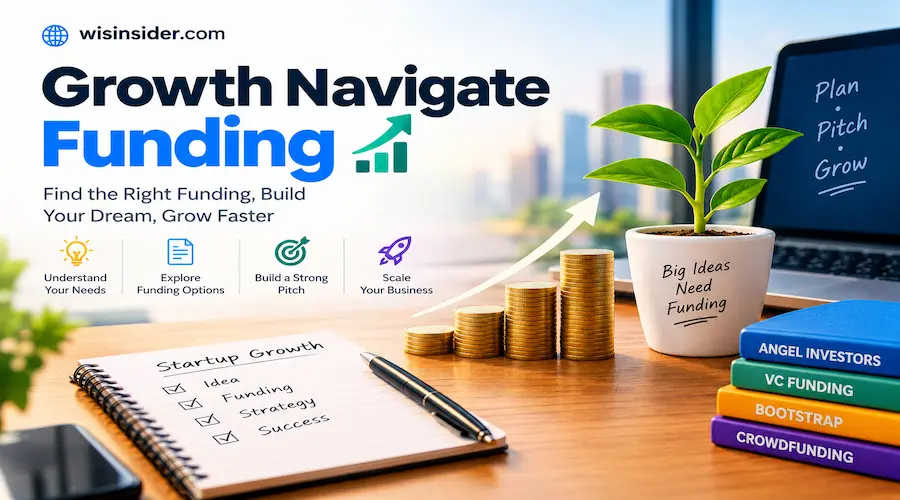
Growth Navigate Funding Explained: Debt, Equity and Grants

Most small businesses do not fail from a lack of ideas. They fail when cash runs out before the idea pays off. Funding decisions matter most in that gap. The wrong money at the wrong time can hurt more than no money at all.
This guide shows you how to choose. You will also see how OpenAI raised record sums, and which lessons fit a small team.
Quick answer: Growth navigate funding means matching the kind of money you raise to the next goal your business must reach. Short cash gaps call for short loans. Big, risky bets call for investors. Fix your numbers first, then raise.
What Is Growth Navigate Funding and What Is It Not?
Growth navigate funding is a way to raise money in the right order. You start with the goal, not the amount. Then you pick the funding that fits that goal.
One 2026 guide frames it as the step between proving your idea and scaling it. I like that view. It forces you to ask what the money will build.
The name can confuse you, so here is the short version:
- Growth Navigate is a company. Its website says it helps businesses get funded and grow faster.
- People also use the phrase for a group of software tools. It has become shorthand for the tools founders use to plan and scale.
- It is not Navigate Commercial Finance. It is a UK broker that helps small firms find lenders.
- It is not a Navigate Accelerator. That is a Miami startup accelerator.
This guide treats growth navigate funding as a method, not a product. Here is my take. Most guides treat funding like a trophy. I think it works better as a tool. Pick it up only when you know what you will build with it.
Plain words box
- Capital: money a business uses to run and grow.
- Runway: how many months your cash will last.
- Dilution: your ownership share shrinks when you sell shares.
- Unit economics: how much you earn or lose on one customer.
Which Growth Navigate Startup Tools Help You Get Funded?
Lenders and investors ask for numbers. Tools help you produce them. Our full guide to growth navigate startup tools covers the whole stack. Here, I focus on the funding side.
These tools work best as a stack, not as one big purchase. Buying ten subscriptions in month one burns startup capital for no gain. Financial technology has made good tools cheap, but cheap adds up.
| Tool | Job | Honest take |
| QuickBooks | Bookkeeping | Many accountants and lenders know it. It can feel heavy for a solo founder. |
| Xero | Bookkeeping | Easy to read for cash tracking. Check that your accountant can use it. |
| Carta | Cap table | Great for tracking who owns what. Too much before your first round. |
| Crunchbase | Investor research | Shows who funds your stage. The best data sits behind a paid plan. |
| PitchBook | Investor data | Deep and detailed. It targets professionals, so expect a high price. |
| DocSend | Deck sharing | Shows who read your deck and for how long. It costs money. |
| Google Analytics | Traffic data | Free and useful. It takes time to learn. |
| Zapier | Automation | Saves hours. Costs can climb as your tasks grow. |
| Attio | CRM | Good for tracking investor talks. Newer, so fewer tutorials exist. |
| Apollo | Prospect lists | Helps with sales outreach. Check the data before you trust it. |
Plans and prices change often, so check each site before you buy.
My advice is simple. In month one, pick two tools. Choose bookkeeping and a basic investor tracker. Add the rest when a real problem appears.
Which Funding Option Fits Your Stage?
Every funding option costs something. You pay with ownership, cash flow, or time. Pick the cost you can live with.
Personal Savings
Personal savings keep you in full control. You answer to nobody. The downside is clear. Your growth has a ceiling, and your own money is at risk. Only invest what you can afford to lose.
Pre Seed
Pre-seed money pays for the earliest version of your business. It covers a prototype, a few customers, and a small team. It often comes from friends, family, angels, and accelerators. At this stage, people back you more than your numbers.
Seed Funding
A seed round is your first real raise. Investors want to see early sales or strong usage. They also want a clear customer and a plan. Show how the money gets you to the next milestone.
Early Stage and Series A
At the early stage, you must prove your model repeats. A Series A investor checks that growth is steady and that each customer pays back what you spent to win them. Later rounds fund expansion, not discovery.
Example Business: Three Ways to Raise $100,000
This is a made up example. Nora runs a candle company with $15,000 in monthly sales. She needs $100,000 for a bigger workshop. She has three paths.
- Small business loan. Say she borrows $100,000 at 12% over five years. She pays about $2,224 each month and about $133,000 in total. She keeps all ownership.
- Angel investor. Say an investor puts in $100,000 at a $1 million pre-money valuation. The post-money value becomes $1.1 million. The investor owns about 9%. Nora owes no monthly payment.
- Savings plus patience. She saves $2,500 a month. It takes 40 months. She owes nothing, but she grows slowly.
No path wins on its own. The loan works if her sales are steady. The investor works if she expects fast growth. Saving works if speed is not urgent. That is growth navigate funding in practice.
Should You Choose Debt, a Loan or Equity?
The core choice is simple. Debt means you borrow and pay it back. Equity means you sell a share of the business.
Small Business Loans and Business Credit
Small business loans suit firms with steady income and a clear use for cash. Think equipment, stock, or a proven ad campaign. Lenders check your cash flow, your time in business, and your credit.
Build business credit early. Keep personal and business money apart. Pay vendors on time. Open a credit line before you need it. Asking for credit in a panic costs the most.
Venture Debt
Venture debt is a loan built for startups that have already raised equity. It can extend your runway with less dilution. Many founders call it cheap money. I disagree. It comes with covenants, which are rules you must follow, and repayment is due even if sales dip. Use it as a bridge to a clear next step, never as a rescue.
Debt Financing vs Equity Financing
| Debt financing | Equity financing | |
| You give up | Future cash flow | Ownership and some control |
| Best for | Steady revenue and a set purpose | Fast growth with high risk |
| If sales drop | You still owe payments | Investors share the loss |
| Speed | Often quicker if you qualify | Slower and relationship based |
Can a Small Business Get Grants?
Business grants are real, but slow and competitive. They also come with strict rules. I treat grants as a bonus, never as the plan. For a tiny team, writing applications can eat weeks that you could spend selling.
OpenAI Grants and the Grant Application
Many people search for OpenAI grants and expect startup cash. The best known program is not built for that. The People-First AI Fund is a $50 million fund that gives unrestricted grants to U.S. nonprofits with 501(c)(3) status. The first wave of applications ran from September 8 to October 8, 2025. openaiopenai
The rules are strict. Each organization can submit only one application, and it must be complete. Reports also said OpenAI would mainly consider groups with an annual budget above $500,000. OpenAI’s page now points to details about a 2026 fund. Check that page before you apply, since dates and rules change.
If you run a for-profit business, this fund is not for you. Look at local, state, or national small business programs instead.
OpenAI Startup Fund, Explained
The OpenAI Startup Fund is a different thing. It is a venture fund founded in 2021 and affiliated with OpenAI. It invests for equity. It does not hand out grants.
How Much Has OpenAI Raised?
OpenAI is the best case study in modern fundraising. It has used almost every kind of funding round. Here is the timeline.
OpenAI Funding History
- Early years. Founders Fund, Peter Thiel’s venture firm, was an early investor in OpenAI.
- Microsoft. Microsoft put in $1 billion in 2019 and $10 billion in 2023.
- Series E. In October 2024, OpenAI raised $6.6 billion at a $157 billion valuation, led by Thrive Capital.
- Series F. In March 2025, it raised $40 billion at a $300 billion valuation, led by SoftBank. SoftBank invested $30 billion of that total.
- February 2026. OpenAI announced a $110 billion commitment at a $730 billion pre-money valuation.
- March 2026. OpenAI closed a $122 billion round at an $852 billion valuation. Amazon agreed to invest $50 billion. Nvidia and SoftBank each put in $30 billion. bloomberglawbloomberglaw
Series E and Series F: The Label Problem
Series names differ by site. One database labels the $122 billion round as a Series G. Another site calls the February 2026 round a Series F. OpenAI does not always use formal letters. When you cite OpenAI’s Series E or Series F, quote the date and amount too. Those two facts settle the confusion.
Why OpenAI’s Total Funding Changes by Source
Sources disagree on OpenAI total funding. One site lists $168 billion or more. Another says roughly $180 billion. A third counts at least $190.6 billion, including a credit facility and secondary sales.
Three things explain the gap:
- Debt. Some trackers count loans. Others count only equity.
- Secondary sales. Existing holders sell shares, so OpenAI does not receive that cash.
- Conditional money. A large part of Amazon’s commitment, reportedly $35 billion, depends on OpenAI going public or hitting a technical milestone.
When you write about OpenAI funding, give a range and name your source.
Who Invested in OpenAI?
Five names stand out:
- Microsoft gave early money and computer help.
- SoftBank led the Series F and co-led the 2026 round.
- Amazon made the largest single commitment in the 2026 round.
- Nvidia invested $30 billion in 2026.
- Thrive Capital led the Series E.
Founders Fund backed the company early. I could not find public deal sizes for that investment, so I will not guess.
The structure changed too. In October 2025, OpenAI created OpenAI Group PBC, a public benefit corporation, while the OpenAI Foundation kept control and a large stake. That change opened the door to bigger raises. l
What Is OpenAI’s Next Round of Funding?
This part moves fast, so read the date. As of October 22, 2026, OpenAI was close to finalizing a round of up to $30 billion at a $1.25 trillion pre-money valuation. UAE investors lead it, alongside Coatue. Reports also named BlackRock among the firms in talks. OpenAI nears up to $30 billion funding round at $1.25 trillion valuation led by UAE investors +2
The deal is not final, and OpenAI calls it an opportunistic bridge before a possible IPO. Sam Altman has ruled out a public debut in 2026, so reports now point to 2027. An IPO needs full filings with the SEC and audited books. That is a big step up from any private round.
Money is flowing because revenue is rising. Bloomberg reported that run-rate revenue reached about $40 billion in August. Even so, OpenAI was not yet profitable when it closed the March round.
Your script matters too. Try a Speechify Chrome extension to hear your pitch read aloud. Awkward lines stand out when you hear them.
What Can Business Owners Learn from OpenAI?
OpenAI is an outlier. Copying its path would be a mistake. Still, a few lessons scale down well.
- Proof comes first. Valuation jumped because usage and revenue jumped. Build proof, then raise.
- Partners bring more than cash. A strategic investor can bring customers or tools. They also bring conflicts, so read the terms.
- Structure matters as much as size. Conditional money is not the same as cash in the bank.
- A bigger valuation is not always better. A high price sets a high bar for your next round.
- A record market can feel tight to you. Carta’s Q1 2026 report counted $30.4 billion of startup funding on its platform, and over 60% went to AI companies. If you are not in AI, expect more careful investors and slower talks.
My view is blunt. Most business owners should chase steady growth before big rounds. Raising money does not fix a weak model. It only delays the problem.
How Do You Plan Cash Flow and Manage Risk Before You Raise?
This is the dull part. It decides whether funding helps you or hurts you.
Cash Flow Management
Profit is an opinion. Cash is a fact. Build a 13-week cash flow forecast and update it every Monday. List what comes in, what goes out, and when. Most cash crises are visible weeks ahead to anyone who looks.
Financial Modeling
A good financial model does not predict the future. It shows how your choices change the outcome. Build three versions: base, best case, and worst case. Investors distrust a model with one line going up.
Track these numbers:
- Burn multiple. How much cash you burn to add one dollar of new revenue.
- Payback period. How long a customer takes to repay what you spent to win them.
- Gross margin and churn. Your profit per sale and how many customers leave.
- Runway. Your months of cash, under honest assumptions.
Solid financial planning also covers your personal side. Keep a safety net outside the company.
Risk Management
Smart risk management protects you before and after a raise.
- Do not depend on one customer, supplier, or lender.
- Do not take debt payments that need your best month.
- Keep a cash buffer, even a small one.
- Read every covenant and clause before you sign.
- Plan for the next round to take longer than expected. It usually does.
How Do You Build a Pitch Deck and Fundraising Strategy?
A pitch deck is not a task for the week before meetings. It is the result of the work above.
A simple structure:
- Problem
- Solution
- Market size, kept realistic
- Traction, such as sales, users, and retention
- Business model and unit economics
- How customers find you
- Team
- Financial model
- The ask, with how much and what it unlocks
Small production steps make a big difference. Learn how to record your screen on Windows so you can film a short product demo. Then practice your pitch on camera and watch it back. You will spot filler words fast.
Build a Process, Not a Hope
A good fundraising strategy works like a pipeline.
- List 40 to 60 investors who fit your stage, sector, and check size.
- Rank them. Talk to your lower-ranked picks first to practice.
- Run your talks inside a tight window so momentum builds.
- Track every conversation in one place.
- Expect due diligence. Prepare a data room with your incorporation papers, cap table, financials, and contracts.
- Compare each term sheet on more than price. Check control, rights, and conditions.
Five Funding Mistakes to Avoid
- Raising to fix a leak. If each customer loses you money, more cash only loses it faster.
- Raising too much. Extra money tempts you to spend. Raise enough to hit your next milestone with a buffer.
- Ignoring the fine print. Covenants and control rights matter as much as the rate.
- Starting too late. Funding takes months. Start while you still have six months of runway.
- Chasing one source. Mix funding options so one no does not end your plan.
FAQ
What is growth navigate funding?
It is a method for raising money in the right order. You set the goal first, then pick the funding that fits it. The phrase also links to Growth Navigate, a company that offers funding and growth advice.
What are growth navigate startup tools?
They are the apps founders use to plan, track, and grow a business. They cover bookkeeping, CRM, analytics, and automation. A lean stack works better than a big one.
How much has OpenAI raised in total?
Estimates range from about $168 billion to over $190 billion. The gap comes from debt, secondary sales, and conditional money. Its latest closed round was $122 billion at an $852 billion valuation.
What was OpenAI’s Series E?
It was a $6.6 billion round in October 2024, led by Thrive Capital, at a $157 billion valuation.
What was OpenAI’s Series F?
It was a $40 billion round in March 2025, led by SoftBank, at a $300 billion valuation.
Did Founders Fund invest in OpenAI?
Yes. Founders Fund appears as an early venture investor. Public deal sizes are not confirmed.
Can my startup apply for an OpenAI grant?
The People First AI Fund serves U.S. 501(c)(3) nonprofits. Most for-profit startups do not qualify. Check OpenAI’s page for current programs.
Is OpenAI raising money right now?
Reports say it is close to a round of up to $30 billion at a $1.25 trillion pre-money valuation. The deal is not final.
Should a small business choose debt or equity?
Steady sales often suit a loan. Fast, risky growth often suits equity. Many businesses mix both.
Your Next Steps
- Write down what the money will build.
- Build your 13 week cash flow forecast.
- Work out your unit economics, burn multiple, and runway.
- Separate personal and business money. Start building business credit.
- Choose your mix of savings, loans, grants, and equity.
- Build your pitch deck and a one-page summary.
- List and rank your investors or lenders.
- Read every term before you sign.
Final Thoughts
OpenAI’s story is a giant version of a simple loop. Prove something, raise to extend it, prove more, and repeat. The numbers are huge, but the logic is the same for you. Know your numbers, guard your cash, and match each type of money to a clear goal. That is growth navigate funding. Steady steering beats a lucky windfall.